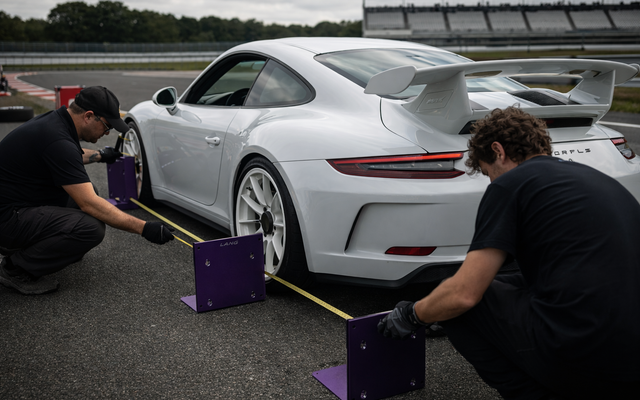
Inside the intensely competitive arena of contemporary serious sliding, podium finishes is no longer purely a function of brute torque or driver courage. Conversely, it has become a intricate engineering challenge that requires a scrupulous marriage of picking a proven vehicle platform, arming it with the highest-quality drift-spec parts, and, most critically, comprehending its real-time characteristics on the track through advanced suspension tuning applications. This exhaustive guide acts as your master plan starting from the very first concept of a drift build right through to the last engineering-refined tweaks that turn a powerful machine into a predictable podium finisher. We will examine in detail the methodical process of car suspension tuning, illustrating how a state-of-the-art vehicle dynamics tool like precise measurement hardware eradicates approximation and offers exceptional clarity into your chassis's real-world dynamics.
The bedrock of any exceptional drift machine is, without question, the chassis itself. Certain platforms have attained renowned standing within the international sliding scene due to their natural weight distribution, robust construction, and the vast ecosystem of specialist components available. Choosing the correct platform is the first and most crucial selection a driver will make. As an example, the BMW's E36 3 Series is universally acknowledged as among the best all-around cars for drifting of history. Its almost ideal 50/50 weight distribution, coupled with a driven rear axle configuration and bulletproof inline-six motors, establishes a chassis that is at once accessible for beginners and incredibly competitive in the hands of a expert pilot. The evolution of this philosophy, the BMW E46 platform, improves on these strengths with a even more refined frame, broader track for greater stability, and yet a greater degree of steering angle as standard from the factory. A distinct powerful option in the pro arena is the C6 generation Corvette.
This American track weapon brings a particular set of strengths to the sliding discipline, such as a light aluminum frame, a transaxle-style drivetrain component that aids in an perfect balance, and the tremendous torque of a big GM LS engine. This blend transforms it into an absolute monster on track, designed of initiating and sustaining long drifts with apparently effortless use of acceleration. For those looking for remarkable value, the Nissan Z33 stands out as a prime candidate. It comes from the manufacturer with a rigid platform, a competent OEM locking differential, and the responsive VQ35DE engine that delivers ample performance for learning and progressing in the discipline. Its successor, the Nissan Z34, brings further refinements in chassis stiffness, suspension design, and overall engine performance, cementing its status as a common choice among competitive competitors. Additional legendary vehicles that warrant mention encompass the agile unique Mazda FC RX-7, the ubiquitous S13 Silvia/240SX, the American SN95 generation Mustang, the modern E90 3 Series, and the compact yet unbelievably fun and instructive MX-5 Miata. Every single one of these chassis provides a different array of traits, complexities, and possibilities, but they all share the core ingredients necessary to be transformed into a capable sliding vehicle.
However, picking the optimal chassis is merely the beginning. To unlock the full capability of any of these cars, significant modifications to the steering and chassis control systems are absolutely non-negotiable. This is where the world of performance tuning parts enters vital importance. The most most game-changing upgrade for a dedicated drift machine is the integration of a high-performance drift angle kit. These engineered assemblies, such as those manufactured by performance brands like SLR, are created to radically increase the vehicle's possible lock-to-lock rotation. A OEM production vehicle is extremely constrained in how far its tires can turn, a engineering limitation for daily use. In oversteer driving, conversely, maximum steering input is continuously needed to manage and maintain a angle. An steering kit substitutes the stock uprights, tie rods, and potentially control arms with pieces that permit the steered wheels to attain degrees of turn over 70 or even 80 degrees, as opposed to a average stock limit of around 40 to 50 °.
This immensely greater lock provides the driver with dramatically enhanced control during a slide, making it much more straightforward to initiate a slide, sustain it through a extended corner, and switch smoothly from one direction to the other. The improvement in handling is absolutely transformative. Coupled with a properly chosen modification is the just as critical enhancement to the chassis's suspension. Store-bought or including high-end sport dampers are generally not engineered for the particular and harsh needs of sliding. A drift-spec system of adjustable dampers is paramount. These specific coilovers incorporate custom piston tuning and spring stiffness that are optimized for the violent load shifting that is inherent of drifting. When a operator initiates a angle, the car's weight is thrown violently to the front of the turn. Proper competition suspension control this shift in a controllable fashion, enabling the vehicle to settle rapidly and giving the operator clear feedback through the controls and cockpit. They also allow for accurate tuning of stance, rebound and compression rate, and corner weighting, which are all key elements of fine-tuning the vehicle's handling to a given circuit or piloting approach. In combination, a precision-engineered angle modification system and a expertly selected pair of drift-spec suspension units form the core physical foundation upon which all later optimization is based.
Once the fundamental components is installed, the next vital step in the project is the meticulous setting of the vehicle's alignment. This is the world of car suspension tuning, a procedure that can appear intimidating to the uninitiated but is, in practice, the key to converting a assembly of fast components into a unified and predictable machine. The most debated aspect of tuning for sliding is undoubtedly negative camber. Camber is the inclination of the tire compared to the upright axis when looked at from the front of the chassis. When the top edge of the wheel is angled towards the car, this is called camber-in. For oversteer driving, an inward tilt on the steering wheels is widely used and is seen as essential. The purpose is fundamentally linked to physics.
When a chassis is cornering at high angles, the frame rolls towards the outside of the corner. This lean causes the outer front tire to reduce its best contact patch with the track surface. By introducing an inward tilt, vehicle dynamics tool the wheel is pre-tilted to counteract this tilt. As the car rolls into the bend, the tire gains a better contact patch against the track, optimizing its grip at the precise time when it is absolutely essential for control. Usually, front angles for a competition drift car vary from approximately -3 degrees to as high as -5 degrees or even beyond, depending on the details of the car geometry, compound choice, and driver style. The back tires also employ negative camber, but the angles are typically more conservative and less aggressive than the front axle. Excessive negative camber at the rear can cause the vehicle to extremely prone to oversteer and difficult to control on power application, as it shrinks the usable grip area of the driven tires during straight-line acceleration. Therefore, rear camber settings are often in the range of -1 degree to -3 degrees, finding a careful compromise between offering sufficient side bite to assist in starting and maintaining the drift while still preserving effective traction for power-down the bend. alignment is merely one component of the more complex alignment equation, which additionally encompasses toe, caster, and bump steer correction.
Toe setting is the orientation of the wheels as seen from above. Toe-in means the leading edges of the tires are closer together than the trailing edges, while outward toe means the opposite. For drifting, a small amount of front axle negative toe is frequently used to sharpen the initial response handling reaction, making the car feel more responsive and willing to start a slide. Rear axle toe setting is generally set to zero or a very minute amount of inward toe to promote stability under throttle. caster angle is the forward or aft angle of the steering axis when observed from the side-on of the vehicle. More positive caster enhances feedback and high-speed solidity, and it additionally increases inward lean gain during steering, which is very useful. Tuning these parameters is a intricate interplay where a modification to one value can and often will affect the remaining parameters. The traditional process for dialing in a chassis's alignment for competition has long been a labor-intensive process of experimentation and feeling. A pilot or engineering group would vehicle dynamics tool make a modification based on experience, test the car on track, use the operator's personal perception and feedback, and then apply an additional change. This process would repeat again and again until the chassis felt "good" or the scheduled track session ended. This approach is not just incredibly slow in terms of man-hours and resources, but it is additionally deeply flawed.
Human perception is a famously unreliable metric, affected by many factors such as tiredness, evolving track grip levels, temperature, and just the mindset of the operator on that given day. What feels "oversteery" on one run might feel "pushing" on the subsequent lap, resulting in contradictory feedback and ineffective changes. This traditional limitation in vehicle dynamics optimization is specifically where state-of-the-art technology has stepped in to completely change the landscape.
The development and integration of advanced vehicle dynamics tools has introduced a radically different era for building and optimizing competitive drift cars. These systems, exemplified by innovative products like GripDial, function by directly measuring the real-time physical performance of the chassis as it is piloted on the course. As opposed to using personal impression, these systems gather quantifiable information on critical parameters such as suspension travel, wheel speed, lateral and longitudinal g-forces, steering angle, and driver input input. This collected information flow is then processed by powerful applications that can graph and analyze the information in a actionable format. For the very first time, tuners and teams can visualize precisely what the car is exhibiting at each moment of a drift. This function changes the entire chassis setup workflow. Think about the specific challenge of setting the front camber for a particular car. As an alternative to introducing a modification from -3 degrees to -3.5 degrees and then testing several laps to try and "feel" a improvement, a telemetry system can give instant and clear feedback. The tool can indicate visually how the tire's contact patch is acting during the most important phases of a drift: the initial flick, sustain, and switch. It can demonstrate if the present angle is allowing the loaded tire to achieve maximum contact or if the compound is over-stressed on its outside edge.
The system can then make data-driven advice for modification. Perhaps the information indicates that the tire is still overworking its sidewall at -3.5 degrees of negative camber, indicating that even more negative camber, say -4 degrees, might be warranted. Alternatively, the information might indicate that the tire is failing to reaching optimal operating temp or that the inner edge is degrading too quickly, which could suggest that there is overly aggressive inward lean and a small reduction back to -3.2 degrees would be more ideal. This level of granularity and actionable analysis was literally unimaginable in the time of pure seat-of-the-pants adjustment.
The benefit of employing a advanced suspension tuning tool goes well beyond merely optimizing alignment. It functions as an priceless suspension tuning guide that is customized to your exact chassis. When setting the rebound and compression values on your coilovers, rather than using imprecise advice or copying another car's settings, you can use the telemetry to analyze how the car is behaving in reaction to your tweaks. The tool can display the suspension travel data over a section of track, revealing if the shocks are handling the body movement effectively or if they are causing the vehicle to become unsettled too much after a flick. It can aid in pinpointing problems like hitting the bump stops or losing droop, enabling you to apply informed decisions to helper springs, rebound/compression rates, or stance. This approach translates equally to the detailed art of suspension geometry optimization. In addition to camber, the software can provide analysis into how modifications to toe and caster are influencing the vehicle's balance during different phases of a lap. For example, it can allow you to ascertain the best amount of front negative toe for your specific steering rack configuration and competition style by measuring the quickness of initial reaction and the stability of the car at lock steering angle. This turns the software an incredibly effective drift suspension tuning guide that is dynamically calibrated by the actual behavior of your personal chassis on the track. It moves the whole project from a dark art into a repeatable optimization procedure.
Furthermore, the application of a platform like data acquisition is in no way confined to expert tuners with large resources. For the amateur enthusiast, it serves as an incredible force multiplier. It effectively provides the tuner with the analysis of a expert suspension specialist without requiring the typical overhead. It drastically shortens the tuning process by delivering unambiguous solutions to problems that would traditionally take years of experimentation to solve. A driver can see how their particular chassis behaves to specific adjustments, gaining a more intuitive comprehension suspension tuning tool of vehicle dynamics in the endeavor. It also makes accessible high-level performance tuning concepts, permitting anyone with the desire to refine their vehicle to accomplish it in a systematic and successful manner. This is especially important in a discipline like oversteer competition, where tuning expertise has historically been a highly secretive commodity among elite crews. Now, that capability can be in the toolkit of any serious builder.
In the final analysis, the process to building and tuning the ultimate championship-contending sliding vehicle is a comprehensive mission that seamlessly integrates classic mechanical wisdom with revolutionary data technology. It begins with the informed selection of a legendary car, followed by the installation of non-negotiable competition parts like maximum-angle angle modification systems and properly valved performance suspension units. The journey then moves into the detailed stage of chassis dynamics adjustment, where settings like camber, toe, and caster are meticulously configured to suit the chassis's new hardware and the driver's personal needs. The final step, and what genuinely distinguishes the modern approach from the past, is the integration of a sophisticated drift telemetry software. This tool eradicates the approximation and waste of solely subjective adjustment by giving quantifiable, real-time information on how the chassis is truly performing. It functions as an unparalleled diagnostic aid, a comprehensive drift suspension tuning guide, and a all-in-one chassis development system. In unison, this integrated approach ensures that every component of the competition vehicle—from the selection of the car to the most minute click on the suspension—is refined for maximum competitiveness on the track. It embodies the complete evolution of the discipline of drifting, connecting physical driving skill with data-informed chassis dynamics to create the ultimate effective cars imaginable.